Slim Fit vs Regular Fit vs Relaxed Fit: Which Men's T-Shirt Fit Is Right for You?
Slim, regular and relaxed are the fit names you'll see most often on men's T-shirts. The difference comes down to how much room the cut leaves through the shoulders, chest and body. A slim fit follows your shape and narrows at the waist. A regular fit hangs straight with a little room to move. A relaxed fit gives you more space through the body, often with a dropped shoulder.
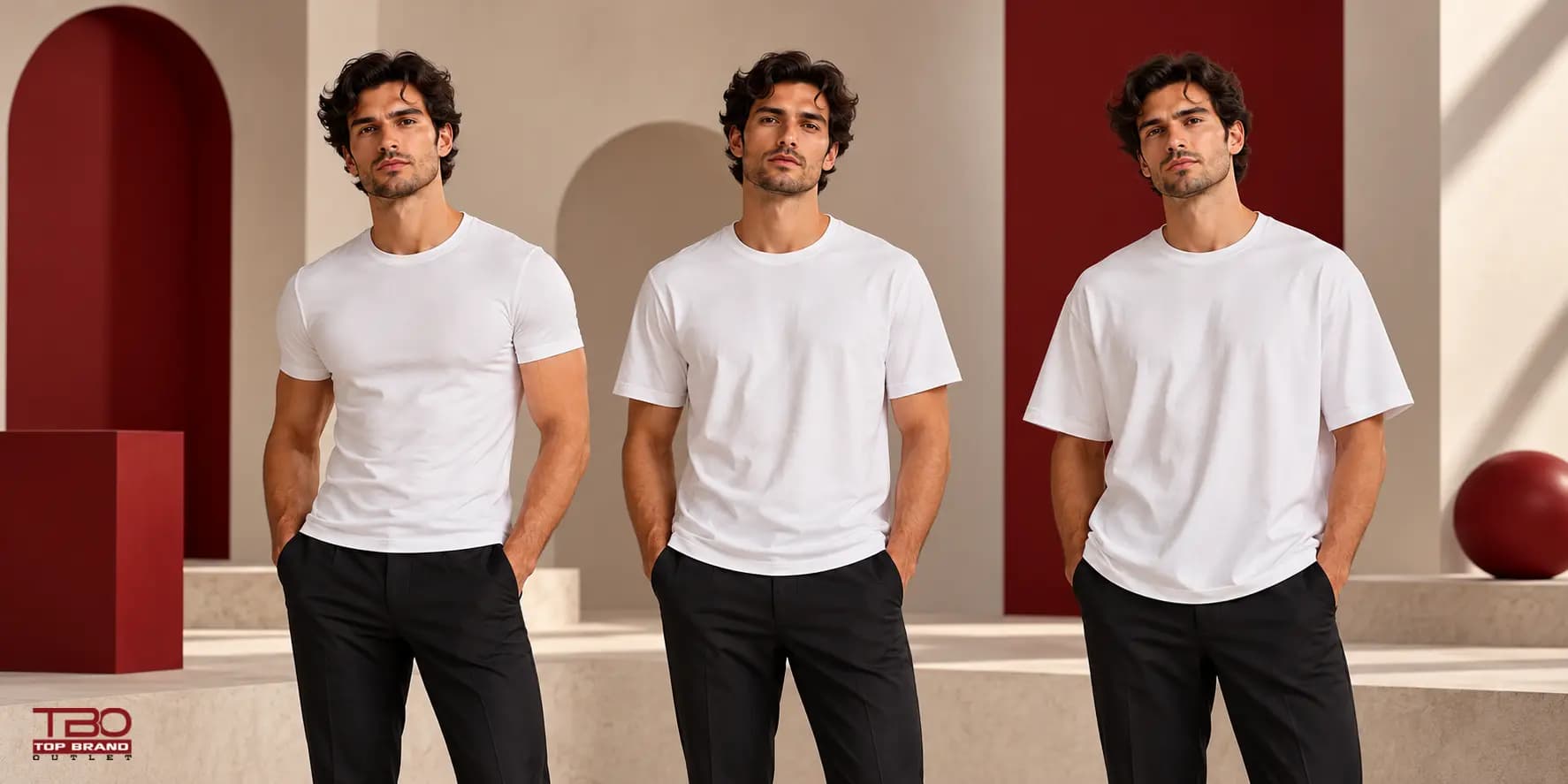
None of them is better than the others. The right fit depends on your build, how you like a T-shirt to feel and what you wear it with. If you're short on time, the table below compares them side by side.
Slim fit vs regular fit vs relaxed fit at a glance
Slim, regular and relaxed fits differ in three places: where the shoulder seam sits, how much room there is through the chest and waist, and how close the sleeves sit to your arm. Oversized and muscle fits are included for comparison, because they're often confused with relaxed and slim. Fit names aren't standardised, so treat this as a guide and check the product description for the cut.
| Fit | Shoulder seam | Chest and waist | Sleeves | Length | Best for | Shop |
|---|---|---|---|---|---|---|
| Slim | On the point of your shoulder | Close through the chest, narrowing at the waist | Narrower, close to the arm | Around the middle of your trouser zip | Lean and athletic builds, layering under jackets | Slim fit T-shirts |
| Regular | On the point of your shoulder | Straight from chest to hem, with some room | Standard width | Around the middle of your trouser zip | Most builds and everyday wear | Regular fit T-shirts |
| Relaxed | At or just past the shoulder point, often dropped | Roomier through the body | Wider, sitting a little lower on the arm | Often slightly longer | Comfort, warm weather, wearing under an open overshirt | Relaxed fit T-shirts |
| Oversized | Clearly dropped | Cut deliberately wide | Longer and wider | Longer | Streetwear-led looks | — |
| Muscle | On the point of your shoulder | Close at the chest and arms | Short and tight on the biceps | Often slightly shorter | Gym-trained builds | — |
What is a slim fit T-shirt?
A slim fit T-shirt is cut close to the body, following the line of your chest and narrowing towards the waist. The sleeves are slimmer too, and the armholes usually sit a little higher, so there's less loose fabric under your arms.
It gives you a clean, sharp outline that works well on lean and athletic builds. It's also the easiest fit to layer, because there's no spare fabric to bunch up under an overshirt, jacket or blazer.
Many slim fit T-shirts include a small amount of elastane, so they stretch and move with you rather than pulling across the chest. Pure cotton versions have less give, so if you're between sizes, take the larger.
Sizing tip: if a slim fit pulls across your chest but the shoulders and length are right, try a regular fit in your usual size. If it feels tight everywhere, shoulders included, go up a size.
Sellers list slim fit T-shirts from labels including Jack & Jones and Diesel.

Slim fit vs muscle fit
A muscle fit is tighter than a slim fit. It sits closer through the chest and arms, with shorter sleeves that hug your biceps. It's designed for gym-trained builds and shows off your shape more than a slim fit does. If you want a neat outline without the cling, slim is the more versatile choice.
What is a regular fit T-shirt?
A regular fit T-shirt is cut straight from the chest to the hem. The shoulder seam sits on the point of your shoulder, and there's enough room to move without spare fabric. It's neither tight nor loose, which is why it suits so many builds.
Choose it when you want one T-shirt that does everything: on its own on a warm day, under an overshirt in spring or beneath a jumper in winter. The straight body also falls cleanly over your stomach.
If you're not sure which fit to go for, start with regular fit T-shirts from labels such as Weekend Offender, True Religion and Diesel.
Regular fit vs classic fit
Many brands use 'classic' or 'standard' for what is essentially a regular fit. A few cut theirs slightly fuller, so check the product description if the difference matters to you.
What is a relaxed fit T-shirt?
A relaxed fit T-shirt gives you more room through the body than a regular fit. The shoulder seam often drops slightly past the point of your shoulder, and many relaxed styles are also a little longer in the body.
It's a comfortable, easy-going fit for warm weather and weekends, and it sits well under an open overshirt. Because the extra room is built into the pattern, take your usual size. A size up makes the whole T-shirt bigger, so the shoulder seams drop further and the hem and sleeves get longer.
For a relaxed cut, look at relaxed fit T-shirts from True Religion and Diesel, among other labels.
Relaxed fit vs regular fit: is relaxed bigger?
Yes. In the same size from the same brand, a relaxed fit is roomier than a regular fit through the chest and body, and the shoulders usually sit lower. Between brands, check the measurements where they're given, because one label's relaxed fit can be close to another's regular. Sizing up a regular fit isn't the same thing: it makes the whole T-shirt bigger without changing its shape.
Relaxed vs oversized vs boxy
Relaxed sits between regular and oversized. An oversized T-shirt is cut deliberately big, with a clearly dropped shoulder, a wide body and longer sleeves that can reach towards the elbow. A boxy fit is wide but shorter in the body, which gives a square outline. Both are popular in streetwear and often used for bold graphic T-shirts.
How should a men's T-shirt fit? A five-point check
A men's T-shirt should fit with the shoulder seams on the point of your shoulders, the sleeves ending halfway down your upper arm, the hem around the middle of your trouser zip, no pulling across the chest and a neckline that lies flat. Check each point in a mirror, first with your arms relaxed and then with them raised.
Shoulders
On a slim or regular fit, the shoulder seam should sit on the point of your shoulder, where the top of your arm begins. If it slips down your arm, the T-shirt is too big. If it pulls in towards your neck, it's too small. Relaxed and oversized fits are the exception, because a lower shoulder seam is often part of the design.
Chest
Pinch the fabric at the side seam, level with your chest. A slim fit should leave a little spare fabric, a regular fit a bit more and a relaxed fit a generous handful. Lines pulling across your chest mean it's too tight there. If the shoulders fit, try a roomier cut in the same size; if they feel tight too, go up a size.
Sleeves
On short-sleeved T-shirts, the sleeve should finish around the middle of your upper arm and sit close without gripping. Sleeves that flare away from your arm or reach towards your elbow make a regular T-shirt look too big.
Length
The hem should cover your waistband and finish around the middle of your trouser zip. Any shorter and it will ride up when you lift your arms. Any longer and it starts to look too big. Relaxed and oversized styles are designed to sit a little lower.
Neckline
A crew neck T-shirt should sit flat around the base of your neck, close enough not to gape but loose enough not to grip. If the neckline has stretched or rippled after washing, the rib has lost its shape, and it will make the whole T-shirt look tired.
Which T-shirt fit suits your body type?
Slim fits suit lean and athletic builds, regular fits suit most builds, and a regular or relaxed fit is usually more comfortable if you carry weight around the middle. Use these as starting points, not rules.
Lean or slight build
Slim and regular fits in mid-weight cotton give you some structure without swamping your frame. A relaxed fit can work too, as long as the shoulder seam still sits close to the point of your shoulder. If it drops too far, the T-shirt looks borrowed.
Athletic or muscular
Slim fits suit a defined chest and arms, and a little stretch keeps them comfortable. If you train and want an even closer fit, look at muscle fits. If slim T-shirts pull across your chest, try a regular fit in the same size. It gives your chest more room, though it will sit looser at the waist.
Broad shoulders
Fit your shoulders first. A regular or slim cut with the seam on the shoulder point looks neat and in proportion. Dropped-shoulder and oversized styles can add width at the top, so skip them if you'd rather not look broader.
Carrying weight around the middle
Choose a regular or relaxed fit in a heavier jersey, which hangs straight from the chest. Make sure the hem covers your waistband comfortably, and avoid slim fits with a lot of stretch, which follow every contour.
Tall or short
If you're tall, check the body length first, because going up a size for length also adds width; a longline style avoids that. If you're shorter, a slim or regular fit that ends around the middle of your zip keeps your proportions balanced. Long, oversized styles can make your legs look shorter.
Colour plays a part too. Darker shades such as black T-shirts show fewer folds and creases, which keeps the outline looking clean.
How do you find the right T-shirt size?
Measure your chest and check it against a size chart, rather than relying on the letter on a T-shirt you already own.
- Measure your chest. Wrap a tape around the fullest part of your chest, under your arms and level all the way round. Stand relaxed, breathe out normally and note the measurement in inches for our size guide, and in centimetres for brand charts that use them.
- Check it against the size guide. Our size guide lists men's sizes from XS to 3XL by chest and waist measurement in inches.
- Use the brand's chart when there is one. Brands cut differently, so where a listing shows the brand's own size chart, trust that one over the general guide. Our size guide notes that designer sizing runs small far more often than it runs large. When you shop designer T-shirts, go by the measurements, not the letter on the label.
For chest, our size guide runs:
| Size | Chest (in) | Chest (approx. cm) |
|---|---|---|
| XS | 34 | 86 |
| S | 36 | 91 |
| M | 38 | 97 |
| L | 40 | 102 |
| XL | 42 | 107 |
| XXL | 44 | 112 |
| 3XL | 46 | 117 |
Is a 40-inch chest a Large or an XL?
On our size guide, a 40-inch (about 102cm) chest is a Large and a 42-inch (about 107cm) chest is an XL. If you measure in between, say 41 inches, the guide recommends the larger size. Where a listing shows the brand's own chart, go by that instead.
How to check the fit without trying it on
Lay a T-shirt that fits you well flat on a table. Measure straight across the chest from armpit to armpit, then from where the shoulder seam meets the collar down to the hem. Where a listing gives garment measurements, compare them with yours.
Should you size up or change the cut?
Going up a size makes everything bigger: the length, sleeves and shoulders as well as the chest. If the shoulders and length fit but the chest feels tight, keep your size and choose a roomier cut. If it feels tight everywhere, go up a size.
Does fabric change the fit?
Yes. Two T-shirts in the same size and cut can fit quite differently, depending on the fabric and how you wash them.
Most T-shirts are made from cotton jersey. Pure cotton T-shirts are soft and breathable, but they need some care in the wash. A small amount of elastane adds stretch and helps a slim fit spring back into shape. Heavier jersey holds its shape better and drapes more cleanly, which also makes a white T-shirt less see-through.

Do cotton T-shirts shrink?
They can. Cotton can shrink a little, especially in a hot wash or a tumble dryer, and it often shows in the length first. Wash at a low temperature and dry flat or on a hanger to help a T-shirt keep its shape, but always follow the care label.
Cotton vs jersey: what's the difference?
Cotton is the fibre and jersey is the way it's knitted. Jersey is a soft, stretchy knit, which is why most T-shirts use it. Jersey can also be knitted from polyester, viscose or blends, so check the fabric composition on the listing when you browse jersey T-shirts.
Do the same rules apply to polos, hoodies and shirts?
Mostly, yes. Slim, regular and relaxed mean much the same across men's tops, but each garment has one extra detail worth checking.
Polo shirts
A regular fit polo should sit like a regular T-shirt, with the collar flat and the placket lying straight, not pulling open. Browse regular fit polo shirts, or try casual polo shirts when you want a collar without dressing up.
Hoodies
A regular fit hoodie should leave enough room to layer over a T-shirt without the sleeves bunching. The hem should sit on your hips and the cuffs at your wrists.
Shirts
A woven shirt has far less give than jersey, so the shoulders and chest need to fit properly, and the collar and sleeve length matter too. In a regular fit, the body falls straight from chest to hem, while a slim fit is shaped through the waist. If regular fit T-shirts suit you, regular fit shirts are the natural place to start.
T-shirt fit FAQs
Which is better, slim fit or regular fit?
Neither is better overall: it depends on your build and how you'll wear the T-shirt. Slim suits lean and athletic frames and layers neatly under jackets. Regular suits most builds, gives you more room to move and works on its own, under an overshirt or beneath a jumper.
Who should wear slim fit T-shirts?
Slim fit T-shirts suit you best if you have a lean or athletic build, especially if your chest is wider than your waist. They're also a good choice if you want a T-shirt to layer under a shirt or blazer. If the fabric pulls across your chest or stomach, a regular fit will look better.
What's the difference between relaxed fit and loose fit?
There's no fixed rule. Some brands use the two terms for the same cut, while others make a loose fit fuller than a relaxed one. Both are roomier than a regular fit, so check the product description and any measurements given, and compare them with a T-shirt you already own.
Should a T-shirt be tight or loose?
Somewhere in between. In a well-fitting T-shirt, the shoulder seams sit on your shoulders, the chest lies flat and the body hangs straight with no excess fabric. Slim fits sit closer and relaxed fits looser, but no T-shirt should grip your chest or hang off your shoulders unless that's the design.
Should I size up for an oversized T-shirt?
Usually not. Oversized T-shirts are cut big on purpose, so start with your usual size and follow any sizing note on the listing. Sizing up a regular fit to get the look is different: the length grows with the width, so it can end up looking baggy rather than deliberately oversized.
Can you wear a T-shirt under a blazer?
Yes. A plain crew neck in a slim or regular fit works well under an unstructured blazer for smart-casual occasions. A white T-shirt is the classic choice, and navy, grey or black are just as easy to wear. Avoid large logos and very relaxed cuts, which bunch under tailoring.
Find your fit
Choose slim for a sharp, close fit, regular for an easy fit that suits most builds, and relaxed for extra room and a softer drape. Check the shoulders, chest, sleeves, length and neckline, then confirm your size against our size guide or the brand's own chart. When you're ready, browse all men's T-shirts.
Products on Top Brand Outlet are listed by vetted third-party sellers. Read how sellers are vetted.

Written by
M RabbaniFounder & Fashion eCommerce Specialist
M Rabbani is the Founder of Top Brand Outlet and a Fashion eCommerce Specialist with a passion for helping customers shop smarter
View all articles →Related articles

Where to Buy Authentic Branded Clothes Online in the UK for Less
Buying branded fashion does not always mean paying full retail prices. UK shoppers can find authentic branded clothes online for less through official brand websites, established fashion retailers, marketplaces and specialist outlets.

Comments
Loading comments…